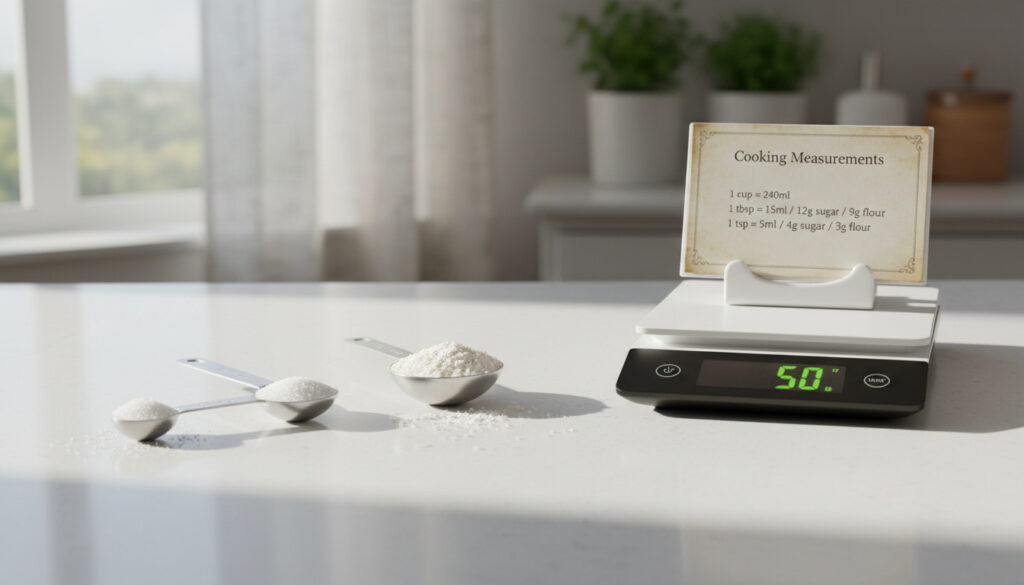
How Many Grams in a Teaspoon – Sugar, Salt, Flour Weights & Chart
The question sounds straightforward. Yet ask how many grams fit into a single teaspoon, and the answer immediately fractures into multiple truths. A teaspoon measures volume—specifically, 4.93 milliliters in the United States—while grams quantify mass. The bridge between these units depends entirely on density, that invisible property determining whether a spoonful of table salt weighs nearly three times more than a spoonful of all-purpose flour.
For home cooks and professional bakers alike, this conversion determines recipe success. A teaspoon of granulated sugar weighs approximately 4.2 grams, while the same volume of water registers at 4.93 grams. These variations explain why precision baking demands scales rather than spoons, and why international recipes sometimes fail when crossed between metric and imperial kitchens.
How Many Grams Are in a Teaspoon?
| Ingredient | Grams per Level Teaspoon | Density Factor | Measurement Context |
|---|---|---|---|
| Water | 4.93g | 1.0 g/mL | Standard reference |
| Granulated Sugar | 4.2g | 0.85 g/mL | Dry crystalline |
| Table Salt | 6.0g | 1.217 g/mL | Fine granulation |
| All-Purpose Flour | 2.6g | 0.478 g/mL | Unsifted, spooned |
Density, not volume, determines final weight. The following principles guide accurate conversion across ingredients and contexts:
- Density, not volume, determines final weight
- The “5 grams per teaspoon” rule applies only to water approximations
- Flour creates air pockets, reducing weight to 2.6g per teaspoon
- Salt’s crystalline structure packs heavily at 6g per teaspoon
- US and metric teaspoons differ by roughly 1.4% in volume
- Heaped measurements increase volume by 50-80% over level spoons
- Professional baking requires gram scales for repeatability
| Measurement Standard | Value | Source Basis |
|---|---|---|
| US Teaspoon Volume | 4.92892 mL | FDA measurement standards |
| Metric Teaspoon Volume | 5 mL | ISO standard |
| Water Weight (US tsp) | 4.93g | Physics (density 1.0 g/mL) |
| Granulated Sugar | 4.2g | UN FAO density tables |
| Table Salt | 6.0g | Density 1.217 g/mL |
| All-Purpose Flour | 2.6g | Density 0.478 g/mL |
| Butter | 4.73g | Dairy fat density |
| Brown Sugar (packed) | 4.5g | Higher density than granulated |
Grams in a Teaspoon of Common Ingredients
How Many Grams in a Teaspoon of Sugar?
Granulated sugar weighs approximately 4.2 grams per level US teaspoon. The exact value derives from sugar’s density of roughly 0.85 grams per milliliter. Brown sugar, when packed, increases to 4.5 grams due to reduced air gaps between crystals.
How Many Grams in a Teaspoon of Salt?
Table salt delivers approximately 6 grams per level teaspoon, making it one of the heaviest common kitchen ingredients. This high density results from salt’s specific gravity of 1.217 g/mL. Kosher salt varies slightly due to larger flake size and increased air space.
How Many Grams in a Teaspoon of Flour?
All-purpose flour weighs merely 2.6 grams per level teaspoon, the lightest of standard baking ingredients. The low density (0.478 g/mL) reflects starch granules’ irregular shapes trapping air. How to Make a Sourdough Starter guides often emphasize that sifting reduces weight further by increasing volume.
One teaspoon of table salt weighs 2.3 times more than one teaspoon of all-purpose flour. When converting recipes, always identify the specific ingredient density rather than applying universal conversion factors.
How Many Grams in a Teaspoon of Butter?
Softened butter registers approximately 4.73 grams per teaspoon, nearly equivalent to water but slightly lighter due to milk fat content. Density varies with temperature; melted butter occupies less volume per gram.
What Is a Teaspoon in Grams for Water?
Pure water serves as the density baseline at 4.93 grams per US teaspoon. This proximity to the common “5 grams” approximation explains why that rule works for liquids but fails for dry ingredients.
Standard conversions assume level teaspoons. Heaped or rounded spoons contain 50% to 80% additional volume, increasing gram weights proportionally. For baking precision, scrape excess with a straight edge.
US vs Metric Teaspoon: Key Differences in Grams
US Teaspoon Volume and Weight
The United States defines one teaspoon as exactly 4.92892 milliliters, established by federal measurement standards. This volume converts to approximately 4.93 grams of water.
Metric Teaspoon Standards
Most countries utilizing the metric system define one teaspoon as exactly 5 milliliters, following ISO guidelines. This 1.44% volume increase results in proportionally higher gram weights for identical ingredients.
Impact on Recipe Accuracy
International recipe translation introduces margin errors. Ten teaspoons of salt in US measurements total 60 grams, while metric teaspoons yield 61.2 grams—a potentially significant deviation in sensitive chemical baking reactions.
Teaspoon to Grams Conversion Chart
The following tables provide precise gram weights for level US teaspoon measurements across common ingredients. Values assume standard densities at room temperature.
Granulated Sugar (1-10 Teaspoons)
| Teaspoons | Grams |
|---|---|
| 1 | 4.2g |
| 2 | 8.4g |
| 3 | 12.6g |
| 4 | 16.8g |
| 5 | 21g |
| 6 | 25.2g |
| 7 | 29.4g |
| 8 | 33.6g |
| 9 | 37.8g |
| 10 | 42g |
Table Salt (1-10 Teaspoons)
| Teaspoons | Grams |
|---|---|
| 1 | 6g |
| 2 | 12g |
| 3 | 18g |
| 4 | 24g |
| 5 | 30g |
| 6 | 36g |
| 7 | 42g |
| 8 | 48g |
| 9 | 54g |
| 10 | 60g |
All-Purpose Flour (1-10 Teaspoons)
| Teaspoons | Grams |
|---|---|
| 1 | 2.6g |
| 2 | 5.2g |
| 3 | 7.8g |
| 4 | 10.4g |
| 5 | 13g |
| 6 | 15.6g |
| 7 | 18.2g |
| 8 | 20.8g |
| 9 | 23.4g |
| 10 | 26g |
King Arthur Baking recommends weighing all ingredients for precision. Their testing indicates 1 cup of all-purpose flour equals 120 grams, implying approximately 2.8 grams per teaspoon—close to standard charts but varying by sifting and packing methods.
The Evolution of Teaspoon Measurements
- : The teaspoon emerges as one-third of a tablespoon in British culinary tradition, originally based on silverware dimensions rather than precise volume.
- : US federal authorities standardize the teaspoon at approximately 4.93 milliliters for pharmaceutical and culinary consistency.
- : ISO establishes the metric teaspoon at exactly 5 milliliters, creating the 1.44% volume divergence still present today.
- : Digital kitchen scales eliminate dependency on volume-to-mass conversion for professional and home bakers.
Established Facts vs. Measurement Variables
| Established Information | Information That Remains Variable |
|---|---|
| US teaspoon = 4.92892 mL (FDA standards) | Exact gram weight of “heaped” teaspoons (varies by 50-80%) |
| Metric teaspoon = 5 mL (ISO standard) | Brand-specific density variations (0.1–0.5g range) |
| Water weighs ~4.93g per US tsp | Humidity effects on flour weight |
| Salt density = 1.217 g/mL | Packing pressure on brown sugar density |
| Conversion formula: grams = tsp × 4.9289 × density | Visual estimation accuracy between individual observers |
Why Precision Matters in Modern Cooking
Baking operates as chemistry. Leavening reactions depend on precise ratios between acids and bases. Ten grams of salt instead of six transforms bread from flavorful to inedible. USDA data confirms that ingredient densities vary significantly by brand and processing method. For more information, see E45 picor de picor crema. E45 picor de picor crema
Professional kitchens abandoned volume measurements decades ago. Home bakers increasingly adopt gram scales, particularly for How to Make a Sourdough Starter and other fermentation processes where microbial activity responds to minute concentration changes.
Authority Behind the Measurements
Weighing ingredients is the most accurate way to measure. While we’ve provided volume measurements for convenience, we recommend using a scale for best results, especially when baking.
— King Arthur Baking Company
Federal standards from the FDA and USDA provide the baseline densities for nutritional labeling. The National Institute of Standards and Technology maintains primary calibration standards for volume measurements used in commerce.
Converting with Confidence
Understanding that a teaspoon holds 4.2 grams of sugar, 6 grams of salt, or 2.6 grams of flour transforms recipe interpretation. While water approximates the simple 5-gram rule, ingredient-specific density charts provide the accuracy necessary for consistent results. For absolute precision, particularly in How to Temper Chocolate or bread baking, digital scales eliminate the variability inherent in volume measurement.
Frequently Asked Questions
Is a teaspoon exactly 5 grams?
Only for water approximations. A US teaspoon of water weighs 4.93 grams. Dry ingredients vary: salt weighs 6 grams, sugar 4.2 grams, and flour 2.6 grams per teaspoon.
How many grams are in a teaspoon of baking powder?
Baking powder typically weighs 4–4.8 grams per level teaspoon depending on brand and composition. Always check specific product density for precise chemical leavening.
Why does flour weigh less than sugar per teaspoon?
Starch granules create irregular shapes trapping air pockets. Flour’s density (0.478 g/mL) is roughly half that of sugar (0.85 g/mL), resulting in 2.6g versus 4.2g per spoon.
Can I measure grams accurately using a teaspoon?
No. Visual estimation introduces 10-20% error. Level spoons help, but humidity, packing pressure, and granulation size create unavoidable variance. Use a digital scale.
Does brown sugar weigh more than white sugar?
Packed brown sugar weighs approximately 4.5 grams per teaspoon versus 4.2 grams for granulated white sugar. The molasses content increases density when compressed.
How do US and metric teaspoons differ in grams?
US teaspoons hold 4.93 mL; metric hold 5 mL. This 1.44% difference increases gram weights proportionally. Ten teaspoons of salt differ by 1.2 grams between standards.
What is the formula for converting teaspoons to grams?
Multiply teaspoons by 4.9289 (US) or 5 (metric), then multiply by the ingredient’s specific density in grams per milliliter.
More related posts
 Age Blood Pressure Chart – Normal Ranges by Age Group
 Italy Lovers Arch Collapses – Facts Timeline and Causes
 Tableau des Médailles 2026 – Norway Leads Projections Canada Third
 iPhone SE 3rd Generation: Specs, Support & 2026 Review
 Natalie Viscuso (2021–Present): Henry Cavill Girlfriend, Age, Job
 Real Madrid vs PSG – Head-to-Head Record and Stats
 Mots Croisés du Jour: Free Daily Crosswords Online