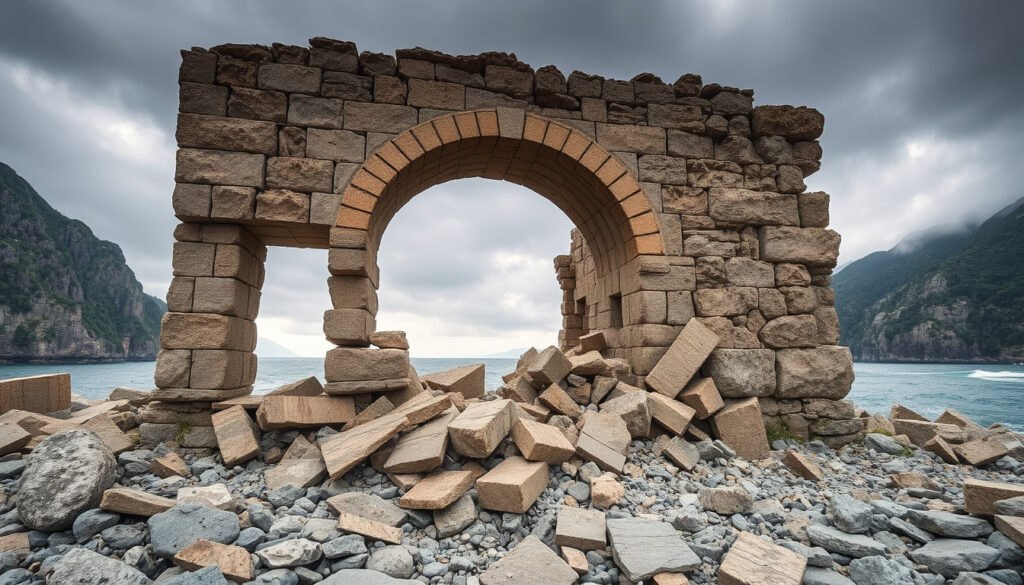
Italy Lovers Arch Collapses – Facts Timeline and Causes
A beloved natural landmark along Italy’s Adriatic coast has collapsed into the sea, marking the end of a formation that for generations drew couples seeking a symbol of lasting love. The Arco degli Innamorati, or Lovers’ Arch, fell on Valentine’s Day 2026 after decades of mounting vulnerability to coastal erosion and storm damage. Local officials have called the loss devastating, both culturally and economically, for the Salento region of Puglia.
The collapse happened in the early hours of February 14, when a storm system already battering the coastline delivered its most forceful assault. Witnesses who visited the site the following morning found only scattered rubble where the iconic arch had once stood. No injuries were reported in connection with the collapse itself.
Geologists and local authorities had long recognized the formation’s fragility. The structure, carved from soft limestone cliffs, had weathered years of salt spray, wave action, and chemical deterioration that progressively weakened its base. Recent extreme weather events accelerated a process that authorities had sought funding to address but had not yet managed to reverse.
What Happened to Italy’s Lovers’ Arch?
The Lovers’ Arch, a natural limestone formation at the Faraglioni di Sant’Andrea sea stacks near Torre Sant’Andrea in Melendugno, collapsed into the Adriatic Sea during the early hours of February 14, 2026. The structure fell on Valentine’s Day, a date that lent particular poignancy to its disappearance given the arch’s association with romantic rituals.
The formation was located in Melendugno, Puglia, not in Rocchetta Nervina in Liguria. Earlier reports suggesting a collapse in that Ligurian municipality appear to have confused separate incidents.
Passers-by discovered the arch’s absence on the mornings of February 15 and 16, finding only isolated rubble and a single remaining pinnacle. Local officials confirmed the collapse shortly afterward, triggering an outpouring of reaction from residents, tourism officials, and regional authorities.
The arch had stood as part of the Faraglioni di Sant’Andrea sea stacks, formed over centuries by the erosion of Calcarenite limestone cliffs. These cliffs are particularly susceptible to salt spray, which crystallizes within rock pores and creates microscopic fractures that weaken the structure over time.
- The arch drew visitors as a backdrop for photographs, marriage proposals, and postcards
- Local legend held that couples who kissed beneath it would enjoy eternal love
- It ranked among the most recognizable natural features along the popular Salento coast
- No injuries resulted from the collapse itself
- The site became a gathering point for mourners in the days following February 14
| Fact | Details |
|---|---|
| Official Name | Arco degli Innamorati |
| Location | Near Torre Sant’Andrea, Melendugno, Puglia (Salento region) |
| Collapse Date | February 14, 2026 (Valentine’s Day, early morning) |
| Immediate Cause | Storm Oriana: heavy rain, high winds, storm surges, pounding waves |
| Contributing Factors | Ongoing coastal erosion, prior Cyclone Harry damage, chemical weathering |
| Casualties | None reported |
| Rock Type | Calcarenite limestone, vulnerable to salt crystallization and wave action |
| Status | Complete collapse; rubble remains; no reconstruction planned |
Why Did the Lovers’ Arch Collapse?
The immediate trigger for the collapse was Storm Oriana, which struck the Salento coast over the Valentine’s Day weekend with days of relentless intensity. Heavy rainfall saturated the already porous limestone, while fierce winds and pounding surf hammered the formation from multiple angles. Storm surges added additional force to waves already breaking directly against the arch’s base.
The Role of Storm Oriana
Meteorological records for the period show that Storm Oriana brought a combination of conditions particularly damaging to coastal rock formations. The storm’s sustained duration meant that waves could repeatedly strike the same weakened points in the structure, progressively loosening material that had held the arch intact.
Cyclone Harry’s Earlier Damage
Prior to Storm Oriana, the arch had sustained damage from Cyclone Harry, which struck southern Italy in January 2026. That earlier storm left the formation more vulnerable than it had been previously, creating cracks and instability that Storm Oriana then exploited. Insurance and damage estimates from Cyclone Harry’s impact on Sicily alone reached approximately €2 billion, underscoring the storm’s severity.
Years of Structural Vulnerability
Geologists have noted that the Calcarenite limestone of the Salento coast faces ongoing chemical and mechanical weathering. Salt crystallization within rock pores expands during dry periods and contracts when moistened, gradually fracturing the material from within. Wave action removes loosened particles, exposing fresh surfaces to the same process. This combination had been slowly eroding the arch’s supporting columns for decades.
Geologist Giovanni Caputo has stated that approximately 53 percent of Puglia’s coastline faces erosion risk. Other cliffs in the Salento area already show visible cracking, suggesting additional formations may face similar instability.
Efforts to protect the arch had been under consideration. In 2024, an application was approved for a €4.5 million grant aimed at erosion protection measures along the coast. However, the funding had not been disbursed before the collapse, leaving the formation exposed to the elements without structural support or intervention.
Where Is the Lovers’ Arch and What Is Its History?
The Arco degli Innamorati stood along the southeastern coast of Italy, in the Salento region of Puglia. The formation was part of the Faraglioni di Sant’Andrea sea stacks near the town of Melendugno, close to Torre Sant’Andrea. These sea stacks are dramatic vertical formations where resistant rock has survived while softer surrounding material eroded away, leaving isolated pillars and arches above the waterline.
The arch formed naturally over centuries as wave action and weathering carved through the Calcarenite limestone. The same processes that ultimately caused its collapse created it in the first place, a reminder of how coastal geology exists in constant transformation. The soft, porous nature of the rock that made the arch visually striking also made it inherently vulnerable to the elements.
Local tradition attributed romantic significance to the formation. Visitors believed that couples who kissed beneath the arch would be granted eternal love, a legend that transformed the geological feature into a site for celebrations and rituals. The arch appeared on countless photographs and postcards, becoming intertwined with the identity of the surrounding coastline.
Significance to Salento Tourism
The Salento coast has long attracted visitors seeking both cultural heritage and natural beauty. The Lovers’ Arch added a distinctive element to the region’s appeal, drawing visitors who might otherwise have passed through coastal towns without stopping. Its presence on social media and travel platforms amplified its reach beyond the immediate area.
Tourism officials in the region estimated that the arch contributed meaningfully to visitor traffic, though precise economic figures vary. Melendugno Mayor Maurizio Cisternino emphasized that its loss dealt a significant blow to the area’s tourism economy, describing the collapse as a “devastating blow to the heart” and comparing it to a funeral.
What Is the Aftermath of the Collapse?
The collapse of the Lovers’ Arch has prompted response from regional authorities, though officials have been clear that rebuilding the natural formation is not possible. As a geological feature reclaimed by nature, the arch cannot be reconstructed through human intervention. The focus has shifted toward assessing damage to the surrounding coastline and preventing similar losses at other vulnerable points.
Statements from Local Officials
Mayor Maurizio Cisternino of Melendugno expressed grief at the loss, calling it an “unwanted Valentine’s gift” and noting that nature had taken back what it had created. The mayor framed the collapse within a broader context of environmental challenges facing the region, emphasizing that the coastline’s vulnerability extends beyond this single formation.
Tourism Councillor Francesco Stella echoed concerns about economic impact, highlighting the significance of the arch to the area’s appeal to visitors. The loss arrives at a time when tourism officials have been working to diversify and strengthen the regional economy following other disruptions.
Regional Response and Prevention Efforts
Puglia’s Infrastructure Secretary Raffaele Piemontese announced plans for coastal inspections in collaboration with affected municipalities. The goal is to identify sustainable interventions that can protect other vulnerable formations and infrastructure without disrupting the natural processes that define the coastline.
Experts have linked the increasing frequency of extreme weather events to climate patterns, noting that medicanes—mediterranean hurricanes—pose growing risks to coastal structures. The combination of rising sea temperatures and shifting storm tracks suggests that similar collapses may become more likely along Mediterranean coasts.
Advocates have renewed calls for the erosion protection funding approved in 2024 but never distributed. Without intervention, other natural landmarks along Puglia’s coast may face the same fate as the Lovers’ Arch. The collapse has served as a catalyst for broader conversations about coastal management and climate adaptation.
Timeline of the Lovers’ Arch Collapse
Understanding the sequence of events leading to the collapse helps contextualize both its causes and its significance.
- Years before 2026: The arch stands as a known landmark, with erosion gradually weakening its structure
- 2024: An application for €4.5 million in erosion protection funding is approved but not disbursed
- January 2026: Cyclone Harry strikes southern Italy, damaging the arch and contributing to its instability
- Early February 2026: Storm Oriana develops and begins affecting the Salento coast
- February 14, 2026: The arch collapses in the early hours of Valentine’s Day
- February 15–16, 2026: Passers-by discover the collapse; officials confirm the loss; crowds gather at the site
- February 16, 2026: News outlets publish detailed reports on the incident
Separating Fact from Uncertainty
While the essential facts of the collapse are established, some details remain unclear or await further investigation.
| What Is Known | What Remains Uncertain |
|---|---|
| Location was near Torre Sant’Andrea, Melendugno, Puglia | Precise structural measurements before collapse |
| Formation collapsed on February 14, 2026 | Long-term tourism impact on the region |
| Storm Oriana was the immediate trigger | Whether other formations face imminent collapse risk |
| Cyclone Harry had weakened the arch in January | Specific timeline for regional coastal inspections |
| No injuries resulted from the collapse | Whether the approved erosion funding will be released |
| The arch was a natural limestone formation | Whether artificial replacements or memorials are planned |
Broader Context: Coastal Erosion in the Mediterranean
The collapse of the Lovers’ Arch reflects a broader pattern affecting coastlines across the Mediterranean region. Rising sea temperatures, increasingly intense storm systems, and decades of coastal development have created conditions where natural formations face mounting pressure. Puglia’s experience illustrates challenges shared by many coastal communities from Spain to Greece.
Geologists studying the region have identified multiple factors that accelerate erosion along limestone coasts. Beyond the immediate effects of waves and salt spray, changes in precipitation patterns alter the frequency of wetting and drying cycles that drive salt crystallization. Sea level rise compounds the problem by placing more rock surface in contact with wave action.
The Lovers’ Arch may serve as an indicator of what lies ahead for other Mediterranean landmarks. Experts note that formations previously considered stable have shown accelerated deterioration in recent years, raising questions about which additional icons might face similar risks.
Voices from the Region
A devastating blow to the heart, to tourism, and to the image of Salento. It feels like a funeral, an unwanted Valentine’s gift from the sea.
— Maurizio Cisternino, Mayor of Melendugno
Nature has reclaimed what nature created. The sea that shaped it has now taken it back.
— Melendugno officials, commenting on the collapse
Residents who had grown up with the formation nearby described it as a piece of personal and community history. For many, the arch represented not merely a scenic backdrop but a marker of identity and belonging tied to the rhythms of the sea and seasons.
Summary
The Lovers’ Arch (Arco degli Innamorati) in Melendugno, Puglia, collapsed into the Adriatic Sea on February 14, 2026, ending a centuries-old natural formation that had become a symbol of eternal love for countless visitors. The collapse resulted from a combination of long-term erosion, damage from Cyclone Harry in January 2026, and the immediate impact of Storm Oriana. No injuries were reported, though the loss has been felt deeply as both a cultural and economic setback for the Salento region.
Regional officials have indicated that rebuilding the arch is not possible, given its geological nature. Instead, attention has turned to inspecting other vulnerable formations along the coast and pursuing the protective funding that had been approved but never distributed. The collapse has intensified calls for climate adaptation measures amid increasing evidence that Mediterranean coastlines face growing risks from extreme weather events.
For those interested in coastal phenomena and climate impacts, the loss of this landmark serves as a case study in how natural formations evolve and disappear over time. Understanding these processes can inform broader conversations about how communities respond to environmental change along coastlines worldwide.
What caused the collapse of Arco degli Innamorati?
Storm Oriana brought heavy rain, high winds, storm surges, and pounding waves that overwhelmed an already weakened structure. Prior damage from Cyclone Harry in January 2026 and years of chemical and mechanical weathering had compromised the formation’s stability.
Was anyone injured in the Lovers’ Arch collapse?
No casualties or injuries were reported in connection with the arch’s collapse. Passers-by discovered it missing on the mornings of February 15–16, 2026.
Where was the Lovers’ Arch located?
The formation stood near Torre Sant’Andrea in Melendugno, a municipality in the Salento region of Puglia, southeastern Italy. It was part of the Faraglioni di Sant’Andrea sea stacks along the Adriatic coast.
When did the Lovers’ Arch collapse?
The arch collapsed in the early hours of February 14, 2026, which was Valentine’s Day. Its absence was confirmed by visitors and officials over the following days.
Will the Lovers’ Arch be rebuilt?
No rebuild is planned. As a natural geological feature, the arch cannot be reconstructed. Regional authorities have instead focused on preventing similar losses at other vulnerable coastal formations.
What is the history of the Lovers’ Arch?
The arch formed over centuries through erosion of soft Calcarenite limestone cliffs. Local legend held that couples who kissed beneath it would enjoy eternal love, making it a popular destination for photographs, proposals, and postcards.
How did heavy rain cause the Lovers’ Arch to collapse?
Heavy rainfall saturated the porous limestone, adding weight and reducing friction within the rock structure. Combined with salt crystallization from decades of salt spray and the force of storm-driven waves, the water infiltration accelerated erosion at critical weak points until the arch could no longer support itself.
What is being done after the collapse?
Puglia’s Infrastructure Secretary announced plans for coastal inspections with affected municipalities to identify sustainable protection measures. Advocates are also pushing for release of previously approved erosion protection funding.
More related posts
 Chicken Thighs in Air Fryer – Crispy Juicy in 20-25 Minutes
 Weak Legacy 2 Codes – Active List and Redemption Guide
 Sarika Cullis-Suzuki: Marine Biologist, CBC Host & Conservationist
 Best Advent Calendar 2025: Beauty, Chocolate Picks
 Animals That Start With E – 130+ Species, Facts and Habitats
 70 Degrees Fahrenheit to Celsius – Exact 21.11°C Conversion Guide
 Kurs Kanadskogo Dollara k Rublyu – 2025 Rate Chart Forecast
 Appartement a Louer Sherbrooke: Rentals, Prices & Guide