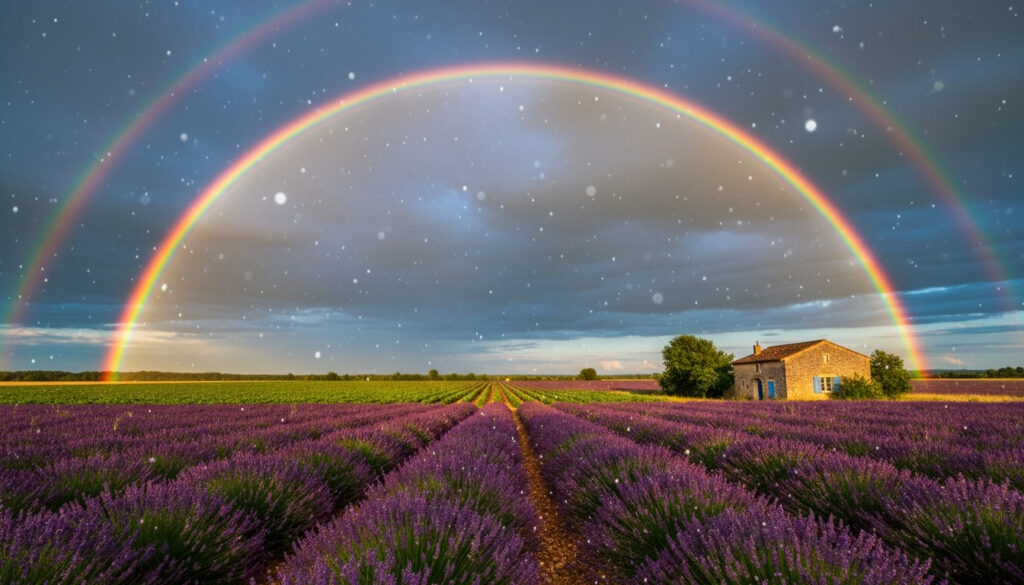
Arc-en-Ciel – French Rainbow Meaning and Science
Arc-en-ciel represents the French linguistic approach to describing one of nature’s most recognizable optical phenomena. The term literally translates to “bow in the sky,” combining arc (arch), en (in), and ciel (sky) to capture the multicolored arc that appears opposite the sun during specific atmospheric conditions.
Beyond its etymological composition, arc-en-ciel carries significant weight in scientific literature and cultural education. French pedagogical materials employ the term in elementary color instruction, while meteorological texts reference it when explaining light refraction through water droplets. Understanding this term requires examining both its phonetic structure and the physical processes that create the phenomenon it describes.
What Does Arc-en-Ciel Mean?
French for “rainbow”
/aʁk‿ɑ̃.sjɛl/ (ark-ahn-syehl)
ROYGBIV spectrum
Refraction + reflection in water droplets
- Arc-en-ciel constitutes an optical illusion dependent entirely on the observer’s position relative to sunlight and precipitation.
- The primary arc appears at approximately 42 degrees from the antisolar point.
- Isaac Newton identified seven constituent colors in the early 18th century, establishing the classification still used in French educational contexts.
- Double formations occur when light reflects twice inside raindrops, creating a secondary, fainter arc.
- The phenomenon requires sunlight behind the observer and water droplets ahead to materialize.
- French folk songs utilize the term to teach chromatic vocabulary to children, embedding it in early education.
| Fact | Detail |
|---|---|
| Literal Translation | Bow in the sky |
| Part of Speech | Noun, masculine |
| Color Sequence | Red, Orange, Yellow, Green, Blue, Indigo, Violet |
| Angular Radius | 42 degrees |
| Primary Condition | Sun behind observer, rain ahead |
| Newton’s Contribution | Identified seven-color spectrum (1704) |
| Modern Classification | Meteorological optical phenomenon |
How Do You Pronounce Arc-en-Ciel?
Phonetic Structure
The International Phonetic Alphabet (IPA) notation for arc-en-ciel is /aʁk‿ɑ̃.sjɛl/. English speakers can approximate this as “ark-ahn-syehl,” with the final syllable blending into a soft “yehl” sound. The word receives equal stress on the first and final syllables in standard Parisian French.
Etymological Components
The compound breaks down into three distinct elements: arc meaning bow or arch (as in a bridge), en translating as “in” or “of,” and ciel meaning sky. This construction evokes imagery of a bow spanning the heavens, a metaphor shared across multiple Romance languages but expressed with particular economy in French.
Educational Usage
French-language educational resources, including those available through PBS Learning Media, employ arc-en-ciel in children’s songs to teach color vocabulary. These pedagogical tools present the sequence as rouge, orange, jaune, vert, bleu, indigo, violet, corresponding to the English ROYGBIV standard. The term serves as an anchor for chromatic education in Francophone preschool curricula.
What Causes an Arc-en-Ciel?
The Physics of Light Refraction
Sunlight enters spherical raindrops and refracts—bending as it moves from air into denser water. Optical physics documentation confirms the light reflects once internally for primary bows, then refracts again upon exiting the droplet. This process occurs at approximately 42 degrees from the antisolar point, creating the arc visible to observers.
Color Dispersion Mechanisms
Shorter wavelengths, such as violet, bend more sharply than longer wavelengths like red when passing through water. Astronomy.com details how this differential refraction separates white light into distinct spectral bands. The resulting color order places red at the outer edge (40-degree angle) and violet at the inner edge (42-degree angle).
Newton’s Seven-Color System
Isaac Newton established the seven-color spectrum classification in his 1704 treatise Opticks, initially identifying five colors before expanding to seven to analogize musical scales. The Smithsonian Institution’s exhibitions note that modern optics sometimes substitutes cyan for indigo, recognizing the continuum nature of light rather than discrete bands.
What Is a Double Arc-en-Ciel?
Secondary arcs require specific solar angles and uniform droplet distribution. They appear when sunlight reflects twice inside raindrops before exiting, creating a secondary formation approximately 10 degrees outside the primary bow.
In secondary bows, red appears innermost rather than outermost. This reversal occurs because the additional internal reflection inverts the light path, flipping the spectrum’s orientation relative to the primary arc. The secondary bow also appears fainter due to light loss during the second reflection.
Despite folklore suggesting physical locations where rainbows end, the arc-en-ciel remains strictly an optical phenomenon with no tangible existence. Meteorological analysis confirms its apparent position shifts as the observer moves, invalidating myths of fixed endpoints.
Supernumerary Phenomena
Faint pastel bands occasionally appear inside the primary violet arc, caused by wave interference patterns explained by Thomas Young’s wave theory of light. These supernumerary bows require uniform droplet sizes and specific viewing angles to become visible.
How Has Scientific Understanding of Arc-en-Ciel Evolved?
- : Aristotle proposes early systematic studies, linking rainbows to meteorological optics but erroneously attributing colors to white-black mixtures.
- : Seneca observes rainbow formation in water sprays and theorizes cloud-mirror reflection mechanisms.
- : Theodoric of Freiberg simulates rainbows using water-filled glass spheres; Persian physicist Alhazen advances understanding of light dispersion.
- : René Descartes publishes quantitative explanations of refraction angles in Discourse on Method, mathematically distinguishing primary and secondary bows.
- : Isaac Newton demonstrates the composite nature of white light through prism experiments during his plague-year isolation.
- : Newton publishes Opticks, formalizing the seven-color spectrum classification.
- : Modern photography and digital imaging enable precise analysis of rainbow optics and atmospheric conditions.
What Is Fact and What Is Fiction About Arc-en-Ciel?
| Scientifically Established | Common Misconceptions |
|---|---|
| Optical phenomenon caused by light refraction in water droplets | Physical bridge or path to other realms (Norse Bifrost mythology) |
| Appears at 42 degrees from the antisolar point | Fixed location with tangible end points |
| Requires specific sun-observer-rain geometry | Visible from all angles simultaneously |
| Double arcs result from two internal reflections | Pots of gold or treasure at the base (Irish folklore) |
| Colors exist as a continuum, not discrete bands | Exactly seven distinct colors existing in nature (Newton’s cultural construct) |
Where Does Arc-en-Ciel Fit in Cultural History?
French educational materials frequently feature arc-en-ciel in children’s programming, utilizing the term to teach both color vocabulary and atmospheric science. Educational resources demonstrate how the concept bridges language acquisition and natural observation in Francophone curricula.
The term maintains particular significance in Quebecois culture, where French linguistic heritage intersects with North American meteorological experiences. Travelers exploring What to Do in Quebec City frequently encounter the term in local art and educational signage, reflecting the province’s French heritage.
Global mythology has historically treated rainbows as tangible structures, from the Norse Bifrost bridge to Valhalla to the Greek goddess Iris using rainbows as celestial pathways. Modern meteorology has replaced these interpretations with optical physics, though the arc-en-ciel retains its symbolic potency across cultures as a representation of hope and transitional beauty.
What Do Primary Sources Reveal About Arc-en-Ciel?
“The rainbow is an image of the sun, wherein the colors appear in a round form, by means of the water in the air.”
— Isaac Newton, Opticks (1704)
Rainbows occur when sunlight enters spherical raindrops, refracts due to entering a denser medium, reflects once internally for the primary bow, and refracts again upon exiting, dispersing into colors because shorter wavelengths like violet bend more than longer ones like red.
— Optical Physics Standards
What Defines Arc-en-Ciel?
Arc-en-ciel designates the French term for the optical phenomenon occurring when sunlight refracts through atmospheric water droplets at approximately 42 degrees, displaying a spectrum of colors from red to violet. Pronounced /aʁk‿ɑ̃.sjɛl/, the word combines architectural and celestial imagery to describe an illusion that has inspired scientific inquiry from Aristotle to Newton while maintaining its role in French cultural education. Those interested in atmospheric phenomena might also explore How to Make a Sourdough Starter, as both processes involve understanding natural fermentation and transformation, though through distinctly different mechanisms.
Frequently Asked Questions
What are the exact colors of the arc-en-ciel?
French educational materials typically list seven colors: rouge (red), orange, jaune (yellow), vert (green), bleu (blue), indigo, and violet. This follows Newton’s classification, though modern optics recognizes a continuous spectrum without distinct boundaries.
Can an arc-en-ciel exist at night?
Moonlight can produce lunar rainbows or “moonbows,” though they appear dimmer and often lack color to the naked eye due to lower light intensity. The physics remain identical to solar rainbows.
Why is the arc-en-ciel circular?
Raindrops scatter light at consistent angles, creating a cone of light from the observer’s perspective. The ground typically cuts off the bottom half, revealing only the characteristic arc.
How does double arc-en-ciel formation differ?
Secondary bows require sunlight to reflect twice inside raindrops before exiting, occurring at approximately 51 degrees with reversed color ordering and reduced brightness compared to primary arcs.
Is arc-en-ciel used in French Canadian culture?
The term appears in Quebecois folklore and education, reflecting shared francophone heritage while adapting to North American meteorological contexts and cultural expressions.
Does arc-en-ciel appear in French literature?
The expression serves as a poetic device in French literature, symbolizing hope or transitions, and appears frequently in children’s educational materials for color instruction.
What angle is required to view an arc-en-ciel?
Primary bows require sunlight to strike raindrops at approximately 42 degrees from the antisolar point, with the observer’s back to the sun and precipitation ahead.
More related posts
 Blake Lively: Career, Family, Controversies and Facts
 Chicken Thighs in Air Fryer – Crispy Juicy in 20-25 Minutes
 Al-Nassr vs Al Akhdoud: H2H, Live Score, Prediction & Stats
 Jake Knapp: Personal Tragedy, Golf Career, and News
 iPhone SE 3rd Generation: Specs, Support & 2026 Review
 Bo Derek: Life, Career, Relationships & FAQs
 Xbox Series X Controller: Best Picks, Compatibility & Guide
 How to Make a Sourdough Starter – Complete Beginner's Guide