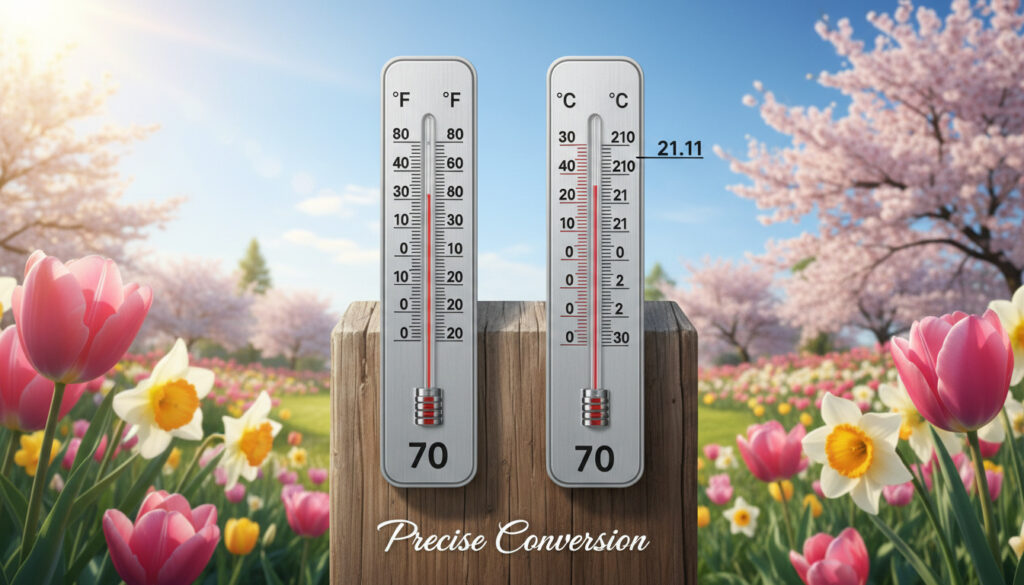
70 Degrees Fahrenheit to Celsius – Exact 21.11°C Conversion Guide
Seventy degrees Fahrenheit translates precisely to 21.11 degrees Celsius. This specific temperature sits at the intersection of meteorological precision and everyday comfort, representing what many consider the ideal indoor environment for residential and commercial spaces.
Understanding this conversion requires more than a rounded approximation. While 21°C offers a quick mental benchmark, the exact value of 21.11°C matters for scientific calculations, How to Temper Chocolate, and engineering applications where thermal precision affects material properties and chemical reactions.
The distinction between these two scales reflects deeper historical and regional divides in how humanity measures thermal energy. From the brine solutions of 18th-century Germany to the metric standardization of modern Sweden, the journey to 70°F reveals as much about cultural preferences as it does about thermodynamics.
What is 70 Degrees Fahrenheit in Celsius?
70°F = 21.11°C
(°F – 32) × 5/9
Comfortable room temperature
Ideal indoor HVAC setpoint
- Precision matters: 21.11°C is the mathematically exact value, not simply 21°C.
- HVAC standard: Heating and cooling systems typically target 70–72°F as the comfort zone.
- Mid-range position: Falls between 68°F (20°C) and 72°F (22.22°C) on the comfort scale.
- Global metric: 21.11°C represents the Celsius world standard for pleasant indoor conditions.
- Culinary relevance: Critical for How Many Grams in a Teaspoon precision in temperature-sensitive recipes.
- Scientific notation: Uses the 5/9 ratio derived from the freezing and boiling points of water.
- Regional variance: While the US uses Fahrenheit, most countries reference 21°C for the same comfort level.
| Fahrenheit (°F) | Celsius (°C) | Context |
|---|---|---|
| 32°F | 0.00°C | Water freezing point source |
| 68°F | 20.00°C | Cool room temperature source |
| 70°F | 21.11°C | Standard comfort zone source |
| 72°F | 22.22°C | Warm room temperature source |
| 98.6°F | 37.00°C | Average human body temperature source |
| 212°F | 100.00°C | Water boiling point source |
How Do You Convert Fahrenheit to Celsius?
The Mathematical Formula
The conversion relies on a linear transformation accounting for the different zero points and scale increments between the two systems. The formula °C = (°F – 32) × 5/9 subtracts the Fahrenheit offset (32 degrees at water’s freezing point) then applies the ratio of scale divisions source.
Mathematically, this derives from the relationship between the scales: Fahrenheit spans 180 degrees between freezing and boiling (212-32), while Celsius spans 100 degrees (100-0), creating the 5/9 reduction factor source.
Step-by-Step Calculation for 70°F
- Begin with the Fahrenheit value: 70
- Subtract 32: 70 – 32 = 38
- Multiply by 5: 38 × 5 = 190
- Divide by 9: 190 ÷ 9 = 21.111…
- Round to two decimal places: 21.11°C source
Reverse Conversion
To convert Celsius back to Fahrenheit, invert the operations: °F = (°C × 9/5) + 32. For 21.11°C: multiply by 1.8 (or 9/5) to get 38, then add 32 to return to 70°F source.
For most household applications, 21°C suffices. However, scientific contexts requiring NIST traceability demand the full 21.11°C precision to avoid cumulative rounding errors in multi-step calculations.
What Does 70°F Feel Like?
Thermal Comfort Perception
Seventy degrees Fahrenheit registers as neutral comfort for the majority of adults in standard clothing. Neither the evaporative cooling of sweat nor the insulating need for heavy layers becomes necessary at this threshold source.
Perception varies slightly by acclimatization. Individuals residing in tropical climates may find 70°F (21.11°C) slightly cool, requiring light sleeves, while those from temperate zones often consider it the baseline for “room temperature” comfort source.
HVAC and Indoor Standards
Heating, ventilation, and air conditioning professionals target 70–72°F (21.11–22.22°C) as the optimal thermostat setpoint for energy efficiency and occupant satisfaction. This range balances metabolic heat generation with ambient thermal conditions source.
What is 70 Degrees Celsius in Fahrenheit?
Reversing the query yields a dramatically different result. Seventy degrees Celsius converts to 158°F using the formula (70 × 9/5) + 32. This represents extreme heat—far beyond human comfort and approaching the thermal danger zone for prolonged exposure.
70°C (158°F) is not a comfortable temperature. It exceeds the threshold for thermal burns with prolonged contact and represents sauna-like conditions well above safe indoor operating ranges.
Travelers occasionally confuse the direction of conversion. While 70°F is pleasant room temperature, 70°C would cause immediate hyperthermia risk. Always verify scale direction when interpreting international weather data or oven settings.
How Did These Temperature Scales Develop?
- – Daniel Gabriel Fahrenheit establishes his scale using brine (0°F), water freezing (32°F), and boiling (212°F) to create 180 divisions between phase changes source.
- – Anders Celsius proposes the centigrade scale, initially setting water boiling at 0°C and freezing at 100°C (later inverted to the modern standard) source.
- – The Celsius scale becomes the SI unit for temperature measurement, adopted globally for scientific and meteorological purposes.
- – Fahrenheit persists in the United States, Belize, and the Bahamas for weather forecasting and consumer products, while Celsius dominates globally source.
How Accurate Is the 70°F Conversion?
Established Facts
- 70°F equals exactly 21.11°C mathematically
- The conversion formula °C = (°F – 32) × 5/9 is internationally standardized
- 70°F falls within the ASHRAE-defined comfort zone of 68–74°F
Variable Factors
- Individual thermal comfort varies by 2–3 degrees based on metabolism and clothing
- Humidity levels alter perceived temperature at 70°F
- Seasonal acclimatization shifts comfort perception by approximately 5°F
Why Do Different Regions Use Different Scales?
The persistence of Fahrenheit in the United States stems from historical precedent and the scale’s finer gradation for weather reporting. Fahrenheit offers 180 degrees between water’s phase changes versus Celsius’s 100, allowing more precise description of ambient conditions without resorting to decimals source.
Celsius aligns with the metric system’s decimal logic, directly correlating to water’s behavior at standard pressure. This makes it superior for scientific calculation, laboratory work, and international commerce where SI units provide universal standardization.
Global adoption patterns reveal Celsius usage in nearly all countries for daily weather, medical measurements, and cooking, while Fahrenheit remains confined primarily to the US consumer market and legacy engineering specifications source.
Where Does This Conversion Data Originate?
“The precise formula for Fahrenheit (°F) to Celsius (°C) is °C = (°F – 32) × 5/9.”
— GeeksforGeeks Educational Foundation source
“For 70°F: (70 – 32) = 38, then 38 × 5/9 = 21.111…°C (rounded to 21.11°C).”
— Cuemath Mathematical Education source
What Are the Key Takeaways on 70°F to Celsius?
Seventy degrees Fahrenheit equals precisely 21.11 degrees Celsius, calculated using (70 – 32) × 5/9. This temperature represents standard room comfort, widely adopted as the HVAC setpoint for residential and commercial spaces. Whether calibrating scientific equipment or adjusting a thermostat, understanding this exact conversion bridges the gap between Imperial and metric thermal measurements.
Frequently Asked Questions
Why does the United States still use Fahrenheit?
The US retains Fahrenheit due to historical infrastructure, consumer familiarity, and the scale’s finer granularity for weather descriptions between 0°F and 100°F covering typical climate ranges.
Is 70°F exactly the same as 21°C?
No, 70°F converts to 21.11°C. While 21°C is close enough for casual conversation, the precise value requires the decimal for scientific accuracy.
What is 70 degrees Celsius in Fahrenheit?
70°C equals 158°F, calculated as (70 × 9/5) + 32. This is dangerously hot, unlike the comfortable 70°F.
How do I convert F to C without a calculator?
Subtract 30 from the Fahrenheit temperature, then halve the result for a rough estimate. For precise results, use (°F – 32) × 5/9.
Why is 70°F considered ideal room temperature?
ASHRAE standards and HVAC engineering identify 70–72°F as balancing thermal comfort with energy efficiency for sedentary adults in typical clothing.
Does humidity affect how 70°F feels?
Yes, high humidity reduces evaporative cooling, making 70°F feel warmer and potentially sticky, while dry air enhances the cooling sensation.
More related posts
 Canadian Tire Peace River: Address, Phone, Hours, Flyer
 The Boss Bear Banff – Facts, Sightings and Safety
 Tour de l’Ile 2025: Date, Start Time, Route & Distances
 Natalie Viscuso (2021–Present): Henry Cavill Girlfriend, Age, Job
 Can Cats Eat Chocolate – Toxicity Risks and Vet Guide
 Saas Bahu Aur Flamingo – Plot Cast Reviews Guide
 Best Advent Calendar 2025: Beauty, Chocolate Picks
 Mots Croisés du Jour: Free Daily Crosswords Online