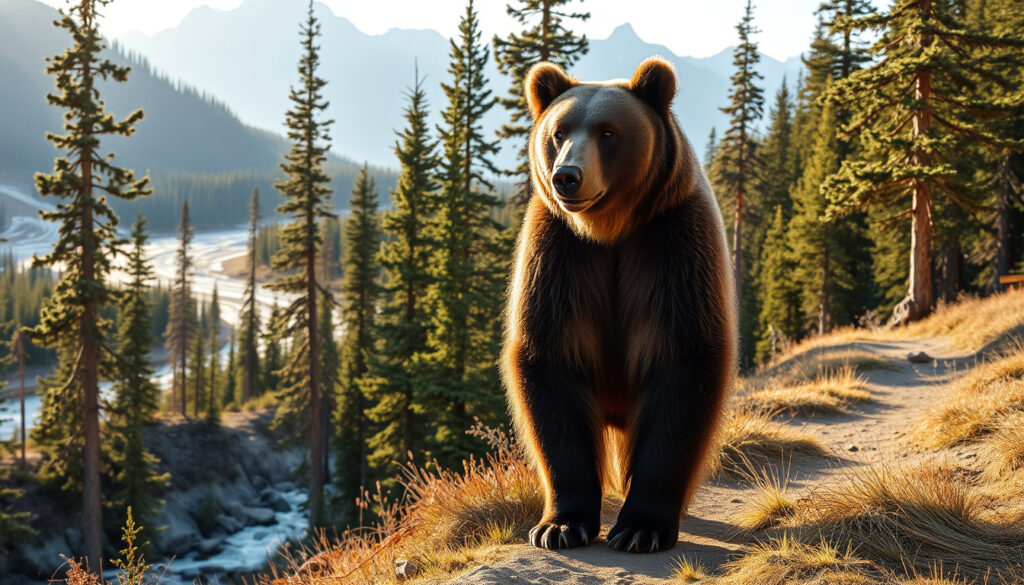
The Boss Bear Banff – Facts, Sightings and Safety
What Makes The Boss Bear Unique in Banff National Park?
Grizzly Bear No. 122, universally known as “The Boss,” stands as Banff National Park’s most celebrated wildlife resident. This dominant male grizzly has commanded attention from researchers, photographers, and visitors alike since his earliest documented sightings in the early 2010s. His combination of remarkable size, extended lifespan, and territorial dominance has elevated him to legendary status within Alberta’s protected wilderness areas.
At an estimated 25 to 28 years old as of 2025, The Boss has surpassed the typical wild grizzly lifespan of 20 to 25 years, with only select individuals reaching their early thirties in the wild. Parks Canada researchers have tracked this bear extensively, documenting his movements across an expansive 2,500-square-kilometre home range that encompasses both frontcountry and backcountry regions of Banff National Park and portions of Kootenay National Park. His continued activity into his late twenties underscores his exceptional adaptation to the Bow Valley ecosystem.
Key Insights Into The Boss Bear
- The Boss fathers an estimated 50 to 70 percent of grizzly cubs born in the Bow Valley, confirmed through DNA analysis from hair samples collected at wildlife overpasses
- He tips the scales at approximately 650 pounds during peak fall weight, dropping to an estimated 500 to 550 pounds each spring following hibernation
- The bear bears visible battle scars on his snout and hindquarters, likely sustained in conflicts with rival Bear No. 136, nicknamed “Split Lip”
- His distinctive appearance includes a chunk missing from his right ear and a previously worn yellow identification tag
- Wildlife photographers and tourists actively seek encounters with The Boss, making him a significant draw for Banff’s wildlife tourism sector
- Parks Canada has implemented strategic closures along the Bow Valley Parkway to manage the influx of observers
- His exceptional longevity for a wild grizzly serves as a marker for successful regional conservation efforts
Snapshot Facts
| Fact | Details |
|---|---|
| Bear ID | Grizzly #122 |
| Nickname | The Boss |
| Habitat | Banff National Park, Alberta |
| Known For | Size, dominance, and frequent sightings |
| Approximate Age | 25-28 years (2025) |
| Peak Weight | ~650 pounds (late fall) |
| Home Range | 2,500 km² |
| Cubs Sired | 50-70% of Bow Valley cubs |
How Does Parks Canada Track and Manage The Boss Bear?
Monitoring The Boss involves a combination of established wildlife research techniques tailored to minimize human interference. Rather than relying on an active radio collar, identification relies on his distinctive physical markers, including the characteristic chunk missing from his right ear, battle scars across his snout and hindquarters, and his imposing overall size. Remote cameras positioned throughout his territory capture images that Parks Canada staff review and cross-reference with historical sighting records.
Parks Canada supplements visual tracking through DNA collection efforts at wildlife overpasses and underpasses along the Trans-Canada Highway. These structures, designed specifically to facilitate safe animal movement across major infrastructure, double as research stations where hair samples accumulate for genetic analysis. This approach enables researchers to confirm The Boss’s continued presence and document his breeding activity without requiring direct contact. Proactive management also includes carcass removal along railway corridors and highway rights-of-way. By eliminating potential food sources that might attract The Boss to dangerous proximity with human activity, Parks Canada reduces conflict risk while maintaining the bear’s natural foraging patterns. The agency maintains a dedicated reporting line at 403-762-1470 for public sightings, allowing citizens to contribute to the ongoing monitoring effort.
Management Strategies and Public Safety
When The Boss occupies high-traffic areas, Parks Canada implements targeted closures to prevent potentially dangerous encounters. The Bow Valley Parkway has experienced intermittent restrictions during his presence, particularly when crowds gathering for sightings create unpredictable situations. Authorities consistently urge visitors to travel in groups, make noise on trails, and carry bear spray as standard precautions during any backcountry activity.
Parks Canada advises reporting bear sightings to 403-762-1470. Visitors should maintain group travel, produce noise on trails, and carry bear spray as essential safety measures.
Social media has amplified awareness of The Boss’s movements, with Parks Canada sharing official sighting images following confirmed encounters. This transparency serves dual purposes: informing the public while reinforcing the importance of maintaining appropriate distance from wildlife. Critics occasionally note that popular interest sometimes overwhelms management capacity, prompting continued evaluation of viewing protocols near active bears.
Where Has The Boss Bear Been Spotted Recently?
The Boss emerged from his winter den on April 7, 2025, marking the latest emergence date recorded in over a decade. Remote camera footage captured in the Lower Bow Valley showed a lean but visibly sizeable bear, consistent with the post-hibernation condition expected at that stage of the annual cycle. This delayed emergence aligns with an aging animal maximizing energy conservation before spring foraging opportunities become widely available.
During 2024, The Boss ranged extensively through the Bow Valley Parkway corridor near established railway tracks. His presence repeatedly drew spectators, prompting Parks Canada to enforce no-stopping zones addressing safety concerns created by crowds. Confirmed sightings span March 18, 2024, with additional documented observations through the spring and summer months.
A notable development occurred on November 3, 2024, when The Boss ventured beyond Banff National Park boundaries into the town of Canmore for the first time on record. He foraged in residential areas north of the Trans-Canada Highway, targeting fruit trees and berry-producing shrubs in suburban settings before retreating to den. Tracks confirmed continued activity until at least December 8, indicating a late-season shift from his typical fall pattern before hibernation commenced.
Historical Emergence Dates
Documented emergence dates reveal considerable annual variation in The Boss’s spring awakening schedule. His 2025 appearance on April 7 represents a significant departure from typical March activity, while the 2024 emergence on March 18 fell within the broader historical pattern. Earlier documented sightings include dates as early as February 28 in 2020, with consistent March appearances throughout the 2014 to 2021 period.
Personal observations from April 4, 2022, documented The Boss actively feeding on a deer carcass, illustrating his opportunistic foraging behaviour and willingness to exploit carrion sources. Such documented feeding events provide valuable data on dietary preferences and energy acquisition strategies during seasonal transitions.
When observing wildlife like The Boss, maintain distances exceeding 100 metres and never position yourself between a bear and its escape route. Avoid running and never attempt to attract his attention. For more information on this topic, please see Boss Bear Banff.
What Is the Timeline of The Boss Bear’s Activity?
Tracking The Boss’s presence across seasons and years reveals consistent patterns interwoven with notable exceptions that reflect his individual character and changing circumstances. The following chronology compiles verified sighting records and documented movements from multiple sources.
- Early 2010s: First notable sightings establish The Boss as a resident male within the Bow Valley population
- 2014–2021: Consistent March emergence dates documented, with annual presence confirmed throughout active seasons
- February 28, 2020: One of the earliest recorded spring emergences during the observation period
- March 14, 2022: Documented emergence; April 4 personal sighting feeding on deer carcass
- March 23, 2023: Typical spring emergence follows historical pattern
- 2024: Extensive Bow Valley activity; November 3 venture into Canmore; tracks confirmed through December 8
- March 18, 2024: Spring emergence recorded
- April 7, 2025: Latest emergence on record; remote camera captures lean but sizeable individual in Lower Bow Valley
What Remains Confirmed and What Is Unclear About The Boss?
Scientific documentation and Parks Canada records establish several key facts about The Boss with high confidence. His identity as Grizzly Bear No. 122 has been confirmed through Parks Canada collar data and ongoing monitoring programs. His impressive physical dimensions place him among the largest documented grizzlies in the Banff region, with peak weights approaching 650 pounds during optimal foraging conditions. DNA evidence from wildlife overpass sampling has definitively established his role as primary breeding male within the Bow Valley, fathering a substantial proportion of the local cub population.
- Confirmed identity as Grizzly #122 via Parks Canada data
- Estimated age of 25-28 years as of 2025
- Home range spanning 2,500 km² across Banff and Kootenay
- Dominant breeding male confirmed via DNA analysis
- Documented emergence dates tracked since early 2010s
- Exact current location varies seasonally; official updates provide most reliable tracking
- Whether yellow ear tag remains or has been removed
- Long-term reproductive contributions as he ages
- Specific den locations used during hibernation periods
Certain aspects of The Boss’s life remain genuinely uncertain despite sustained research attention. His precise movements within his expansive territory defy continuous tracking, and seasonal variations in food availability influence his location unpredictably. While ongoing monitoring through official channels provides the most reliable current information, the inherent challenges of observing a solitary animal across rugged terrain limit comprehensive understanding of daily activity patterns.
Why Is The Boss Bear Significant to Banff’s Ecosystem?
The Boss occupies a pivotal ecological position within Banff National Park’s grizzly population. His dominant breeding status means he substantially influences the genetic composition of future generations within the Bow Valley subpopulation. With confirmed paternity of 50 to 70 percent of cubs born in recent years, his reproductive contribution exceeds what would typically occur in a more distributed breeding structure.
Beyond reproduction, his predatory behaviour shapes local dynamics by preying on black bears and competing aggressively with rival males. These interactions redistribute hunting pressure and territorial access throughout the ecosystem, affecting species ranging from deer and elk to smaller omnivores competing for similar food resources. His continued survival into late adulthood demonstrates successful navigation of natural challenges including competition, food scarcity, and human infrastructure hazards.
From a conservation perspective, The Boss represents measurable progress in Banff’s grizzly recovery efforts. The park’s population suffered severe declines during the 20th century, and sustained monitoring programs track demographic recovery. His exceptional longevity and breeding success provide concrete metrics demonstrating that protected area management strategies yield tangible results for a species classified as threatened throughout much of its North American range.
What Sources Document The Boss Bear’s Story?
Parks Canada maintains the most authoritative records through official wildlife monitoring programs. Agency reports on grizzly bear populations in Banff National Park provide baseline data, while specific wildlife bulletins document individual sighting confirmations. Parks Canada publishes nature and wildlife information relevant to visitor safety and ecological understanding.
Field reporting from regional outlets including the Rocky Mountain Outlook has provided detailed first-hand accounts of The Boss’s emergence and activity patterns. Wildlife photography documentation from sources like Mountains and Treasures supplements official records with visual evidence useful for identification purposes. These independent observations contribute valuable data points while maintaining appropriate editorial standards.
The Boss is back. Banff’s most famous grizzly bear has emerged from his den in the park. Remote cameras captured the iconic male grizzly on April 7, 2025, in the Lower Bow Valley.
Parks Canada encourages public participation through their sighting reporting system, transforming passive park visitors into active research contributors. This crowdsourced monitoring approach extends observational capacity across the park’s vast territory while fostering public engagement with wildlife conservation. Visitors encountering The Boss or other bears can report observations to 403-762-1470, contributing to the collective understanding of these animals’ movements and behaviours.
Key Takeaways About The Boss Bear
Grizzly Bear No. 122, universally known as The Boss, represents Banff National Park’s most prominent wildlife resident. At 25 to 28 years old, he has surpassed typical wild grizzly longevity while maintaining dominant status within the Bow Valley population. His documented paternity of the majority of cubs born locally confirms his central role in regional grizzly genetics, while his extensive 2,500-square-kilometre territory underscores the scale of movement patterns characteristic of healthy male grizzlies.
Recent documented appearances, including his April 2025 emergence on the latest date in over a decade, demonstrate continued vitality despite advancing age. His November 2024 venture into Canmore revealed unexpected adaptability as he exploited suburban food sources before returning to natural denning areas. Parks Canada continues monitoring this iconic bear through remote cameras, DNA sampling at wildlife crossings, and public sighting reports, ensuring conservation strategies reflect current population dynamics.
Frequently Asked Questions
How old is The Boss bear in Banff?
When did The Boss bear emerge from hibernation in 2025?
How big is The Boss bear?
How does Parks Canada track The Boss bear?
How many cubs has The Boss fathered?
What is The Boss bear’s home range?
What should visitors do if they spot The Boss bear?
Why did The Boss enter Canmore in November 2024?
More related posts
 York University Acceptance Rate – 2024 Stats and GPA Guide
 How to Make a Sourdough Starter – Complete Beginner's Guide
 President’s Choice Mastercard Login: PC Financial Guide
 English to Russian Translate – Best Free Tools 2025
 400 Euro to CAD is 646.92: Live Xe Rate & Converter
 Sarika Cullis-Suzuki: Marine Biologist, CBC Host & Conservationist
 Real Madrid vs PSG – Head-to-Head Record and Stats
 Leonardo DiCaprio Net Worth – $300 Million Breakdown 2024