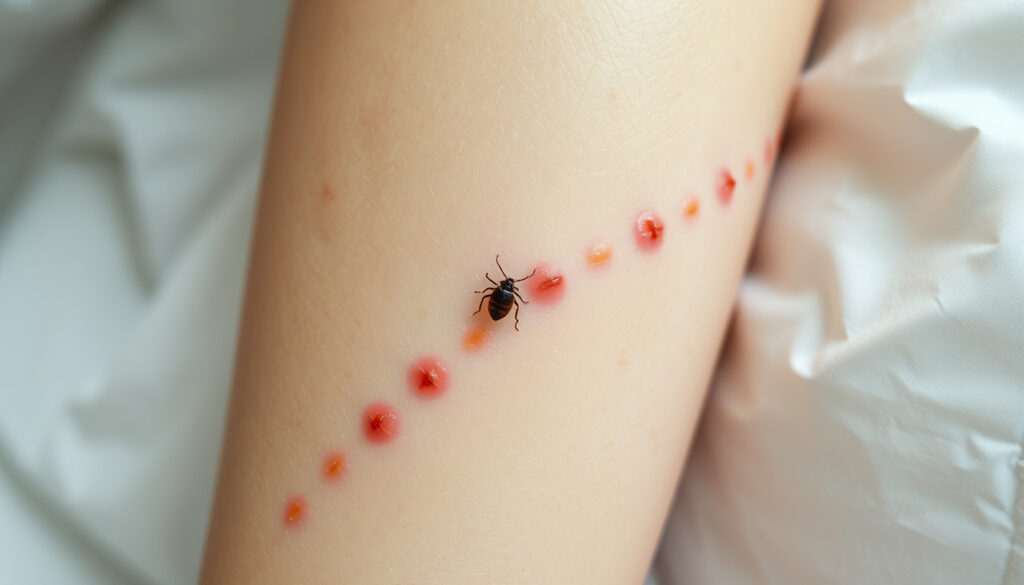
What Do Bed Bug Bites Look Like: Pictures & ID Guide
Waking up with itchy bumps you didn’t have when you went to sleep is unsettling enough—but trying to figure out what’s actually going on can feel like solving a mystery with no witnesses. Bed bug bites are notoriously easy to misidentify, and the way they look on your skin depends heavily on your skin tone. Here’s how to actually tell them apart.
Typical appearance: Red, itchy bumps in lines or clusters · Affected skin areas: Exposed areas like arms, legs, neck · Reaction rate: 70% develop raised welts · Pattern options: Random, straight line, or zigzag · On dark skin: Purple welts
Quick snapshot
- Bites appear on exposed skin (Cleveland Clinic)
- Often arranged in lines, zigzags, or clusters (Medical News Today)
- Heal in up to 2 weeks (Black Skin Directory)
- Reaction intensity varies widely by person
- Some people show no visible marks at all
- Exact timeline differs between individuals
- Bites develop seconds to weeks after the bite (Medical News Today)
- Full healing takes up to 2 weeks
- Dark marks can persist for months
- Confirm the source: check bedding for signs
- Treat symptoms with hydrocortisone or antihistamines
- Call pest control if infestation is confirmed
| Characteristic | What to look for |
|---|---|
| Shape | Flat, raised, or blistered |
| Color | Red on light skin, purple on dark |
| Arrangement | Lines, clusters, zigzag |
| Itch level | High for most victims |
| Onset | Hours to days |
What Do Bed Bug Bites Look Like?
Bed bug bites typically appear as small, flat or slightly raised areas that become inflamed, itchy, and sometimes blistered. According to pest control experts at Cleveland Clinic (authoritative medical institution), these bites often show up in characteristic patterns—straight lines, zigzags, or random clusters on exposed skin.
On lighter skin, the classic presentation is red, puffy bumps with a darker center, almost like tiny pimples. On darker skin tones, the appearance shifts to purplish, deeper brown, or very dark red welts that are less immediately recognizable as irritation, according to health resources compiled by the Black Skin Directory (Black skin health resource).
Pictures and close-ups
- Light skin: Bright red or pink raised bumps, often with a dark red center mark
- Dark skin: Purplish, violet, or deep brown welts that blend more with natural pigmentation
- Both: Clusters of three or more bites are common; individual bites are typically 1–5mm
The GoodRx health resource (prescription savings platform with medical content) notes that pictures on darker skin show bites appearing brown, violet, or nearly skin-colored—often healing with brown hyperpigmentation that can take months to fade.
Stages of bed bug bites
| Timeframe | Appearance |
|---|---|
| Initial bite | Small flat spot; may go unnoticed |
| Hours to days | Bump swells, becomes itchy, color intensifies |
| Days to 1 week | Peak inflammation; may blister |
| 1–2 weeks | Begins healing; itching subsides |
| Weeks to months | Dark marks fade on light skin; hyperpigmentation may persist on dark skin |
The natural pigmentation and higher melanin in Black skin can make red welts harder to spot, potentially delaying identification of a bed bug problem, according to Find a Black Doctor (medical directory specializing in diverse skin tones).
How Do You Tell if a Bite Is a Bed Bug?
No single feature confirms a bed bug bite on its own—identification relies on the combination of pattern, location, and timing. Medical News Today (health information publication) describes bed bug bites as raised itchy bumps that appear in lines, zigzags, or clusters of three or more on exposed skin areas.
Patterns and groupings
- Linear pattern: Three or more bites in a straight line—classic “breakfast, lunch, and dinner” pattern
- Zigzag: bites arranged in a random but directional pattern
- Cluster: Multiple bites grouped together in a small area
- Random: Scattered single bites across the body
Timing of reaction
Reaction time varies significantly. Orkin (pest control authority) notes that bites may appear within hours, days, or not at all. Research compiled by Medical News Today indicates that bites can develop anywhere from seconds to weeks after the actual bite occurs.
Not everyone reacts visibly—some people may be bitten nightly for weeks without a single mark on their skin.
About 70% of people develop visible raised welts, which means roughly 30% may have no visible reaction at all—yet still be experiencing systemic exposure to bed bug saliva.
What Can Be Mistaken for Bed Bug Bites?
Several common skin conditions and insect bites look similar enough to cause confusion. Orkin (pest control authority) distinguishes bed bug bites from flea and mosquito bites by their characteristic linear or clustered arrangement.
Mosquito bites
- Single bumps rather than patterns
- Appear immediately and itch intensely right away
- Location: Often on exposed areas, but without the “breakfast, lunch, dinner” line
Flea bites
- Small clusters or patterns around ankles and lower legs
- Immediate itching that starts within minutes
- Character: Smaller, with a red halo around a central dark spot
Other skin reactions
- Allergic reactions: Can appear anywhere, often more widespread
- Hives: Larger, more irregular welts that change shape
- Contact dermatitis: Localized to areas that touched an irritant
- Scabies: Intense itching at night; burrow tracks between fingers
The distinguishing feature of bed bug bites is the pattern—lines, zigzags, or clusters of three or more bites appearing on skin that was covered during sleep, according to Prevention (health publication).
If you see bites only on skin that was under blankets or sheets, arranged in lines or clusters, bed bugs become a prime suspect—even if you can’t spot the bugs themselves yet.
What Part of the Body Do Bed Bugs Bite the Most?
Bed bugs feed exclusively on exposed skin while their host sleeps. Orkin (pest control authority) identifies the most commonly affected areas as arms, legs, face, neck, and hands—all areas typically left uncovered during sleep.
Common areas
- Arms: Often both upper and lower, especially the outer surfaces
- Legs: Shins and calves are frequent targets
- Neck and shoulders: Areas that extend beyond pillow or blanket coverage
- Face: Less common but can occur if face is uncovered
- Hands: Top of hands more than palms
Why those spots
Bed bugs don’t burrow under clothing or through fabric. They seek the path of least resistance—uncovered skin with good blood flow. The insects can detect carbon dioxide from breathing, which is why bites frequently appear near the head and shoulders where exhaled breath collects under covers.
A bed bug feeds for up to 10 minutes before detaching, so they prefer skin areas that stay relatively still during sleep.
Do Bed Bug Bites Itch?
For most people, bed bug bites cause intense itching that can disrupt sleep. Black Skin Directory (Black skin health resource) notes that on darker skin, bites can also be painful, inflamed, warm, and swollen even when the color change is subtle.
Do bed bug bites hurt?
While primarily an itchy nuisance, bed bug bites can be painful—especially if scratched raw, if blisters develop, or if the skin is sensitive. Most people describe the sensation as a burning itch rather than sharp pain.
Treatment for bed bug bites
- Clean: Wash with soap and water
- Cold compress: Apply for 10–15 minutes to reduce swelling
- Hydrocortisone cream: Over-the-counter 1% strength reduces inflammation and itch
- Antihistamines: Oral Benadryl or cetirizine reduces allergic reaction and itch
- Avoid scratching: Breaks in the skin can lead to infection
According to the Black Skin Directory (Black skin health resource), bites typically heal within two weeks but may leave dark marks that persist for months—particularly on darker skin tones where post-inflammatory hyperpigmentation is more noticeable.
If bites become increasingly painful, discharge fluid, develop extensive swelling, or show signs of infection (increasing redness, warmth, fever), medical attention may be needed to rule out allergic reaction or secondary bacterial infection.
Upsides
- Bed bug bites rarely cause serious medical complications
- They heal on their own within two weeks
- Treatment is simple and over-the-counter
- Bites can serve as early warning of an infestation
Downsides
- Intensely itchy and disruptive to sleep
- Delayed reactions make identification difficult
- On dark skin, dark marks may persist for months
- Confirming the source requires finding actual evidence of bugs
How to Confirm a Bed Bug Infestation
Finding the actual bugs or their signs is the only way to confirm your bites came from bed bugs rather than another source.
- Check bedding seams and corners—adult bed bugs are roughly 3/16 to 1/4 inch long (Harvard Health), oval, flat, and reddish-brown
- Look for dark or rusty stains—tiny black dots of digested blood (fecal spots) on sheets or mattress
- Inspect mattress tags, seams, and headboard—bed bugs hide in crevices during daylight
- Check for shed shells or eggs—nymphs are translucent and nearly invisible; eggs are pearl white and pinhead-sized (Harvard Health)
- Call a licensed pest control professional if you find evidence— DIY treatment rarely eliminates infestations completely
“Bed bug bites on Black and brown skin may not always show up angry and bright red. Rather, the skin can look purplish, flush a deeper brown, or very dark red.”
— Black Skin Directory (Black skin health resource)
“The natural pigmentation of the skin can make it challenging to spot the red welts typically associated with these bites.”
— Find a Black Doctor (medical directory specializing in diverse skin tones)
“Everybody is different. Bedbug bites appear differently on different people.”
— Pest identification expert (YouTube pest identification video)
Bed bugs are not a sign of poor hygiene—they infestre hotel rooms, clean apartments, and pristine homes equally. The Black Skin Directory (Black skin health resource) confirms that bed bug infestations have nothing to do with how clean or dirty a living space is.
For renters and homeowners, the next step is straightforward: if you’ve confirmed bites and found evidence of the bugs themselves, call a licensed exterminator. Heat treatments are among the most effective methods, reaching into crevices that sprays cannot, according to GoodRx (health resource platform).
Related reading: Dark Spots on Face · Cetaphil Gentle Skin Cleanser
Waking up with red, itchy bumps in lines or clusters often signals bed bugs, as shown in this detailed picture ID guide for accurate identification.
Frequently asked questions
What are the first signs that you have bed bugs?
Small red or dark stains on bedding (from digested blood), tiny black fecal dots, shed nymph shells, or tiny pearl-white eggs in mattress seams. You may also wake with unexplained itchy bites in lines or clusters.
What are three signs you might have bed bugs?
1) Unexplained bites in linear or clustered patterns on exposed skin during sleep; 2) Dark or rusty spots on sheets from bed bug feces; 3) Live insects visible in mattress seams, headboard crevices, or baseboard cracks.
How do you know if you get bitten by bed bugs?
The most reliable signs are bites appearing in lines, zigzags, or clusters on arms, legs, neck, or shoulders—skin exposed during sleep—combined with physical evidence of bugs in your sleeping area.
How to get rid of bed bugs?
Professional heat treatment or insecticide application is typically required. Wash bedding in hot water, vacuum thoroughly, and seal mattress seams. Call a licensed pest control company; DIY treatments rarely eliminate established infestations.
What kills bedbugs instantly?
Extreme heat (120°F/49°C or higher for sustained periods) kills bed bugs at all life stages. Professional heat treatment units raise room temperature above this threshold. Diatomaceous earth and certain insecticides can also kill them, but eggs are more resistant.
No signs of bed bugs but I have bites?
Bites without visible evidence may indicate a new infestation, bites from elsewhere (hotel, office), or bites from another source entirely. Inspect sleeping areas thoroughly at night with a flashlight, or call a pest inspector for a professional assessment.
More related posts
 York University Acceptance Rate – 2024 Stats and GPA Guide
 Cirrhosis of the Liver – Causes, Symptoms, Stages and Treatment
 Pacers vs Milwaukee Bucks Match Player Stats: Box Scores & More
 Land for Sale Ontario – Prices, Listings and Best Areas
 Whoop-Up Days 2025: Dates, Parade, Tickets & Schedule
 iPhone SE 3rd Generation: Specs, Support & 2026 Review
 Toronto Blue Jays vs Seattle Mariners Timeline – Head-to-Head Record & Stats
 Commission Scolaire de Laval – Schools, Contacts and Enrollment Guide